
The short answer
If your AC blows warm air, will not start, freezes up, leaks water or trips the breaker, it usually needs a diagnosis rather than a guess. We test the electrical parts, refrigerant circuit and airflow, explain the cause and repair it once you approve.
Central air conditioners in the Santa Clara Valley have an odd life. They sit quietly through a mild, damp winter, then get asked to run for hours on end once the dry summer heat settles in, especially in the inland and southern parts of the valley where afternoons climb well past what you feel near the Bay. That sudden jump in workload is when weak parts give out. ReliableAir HVAC Services repairs air conditioners in San Jose, Santa Clara, Milpitas, Sunnyvale, Campbell, Cupertino and neighboring cities, and every repair starts with finding out exactly what failed.
Symptoms that mean your air conditioner needs attention
Most cooling failures announce themselves before the system stops entirely. Paying attention to the early signals can turn an emergency into an ordinary appointment. These are the ones South Bay homeowners describe to us most often:
- The indoor blower runs but the air from the vents is barely cool
- The outdoor unit hums or clicks yet the fan does not spin
- Ice forms on the copper line near the outdoor unit or on the indoor coil
- Water pools around the furnace or air handler in a closet, garage or attic
- The breaker for the condenser trips during hot afternoons
- Short cycles where the system starts and stops every few minutes
- Rattling, squealing or grinding noises that were not there last year
- Rooms upstairs or at the far end of the house never reach the set temperature
What our technician checks during a repair visit
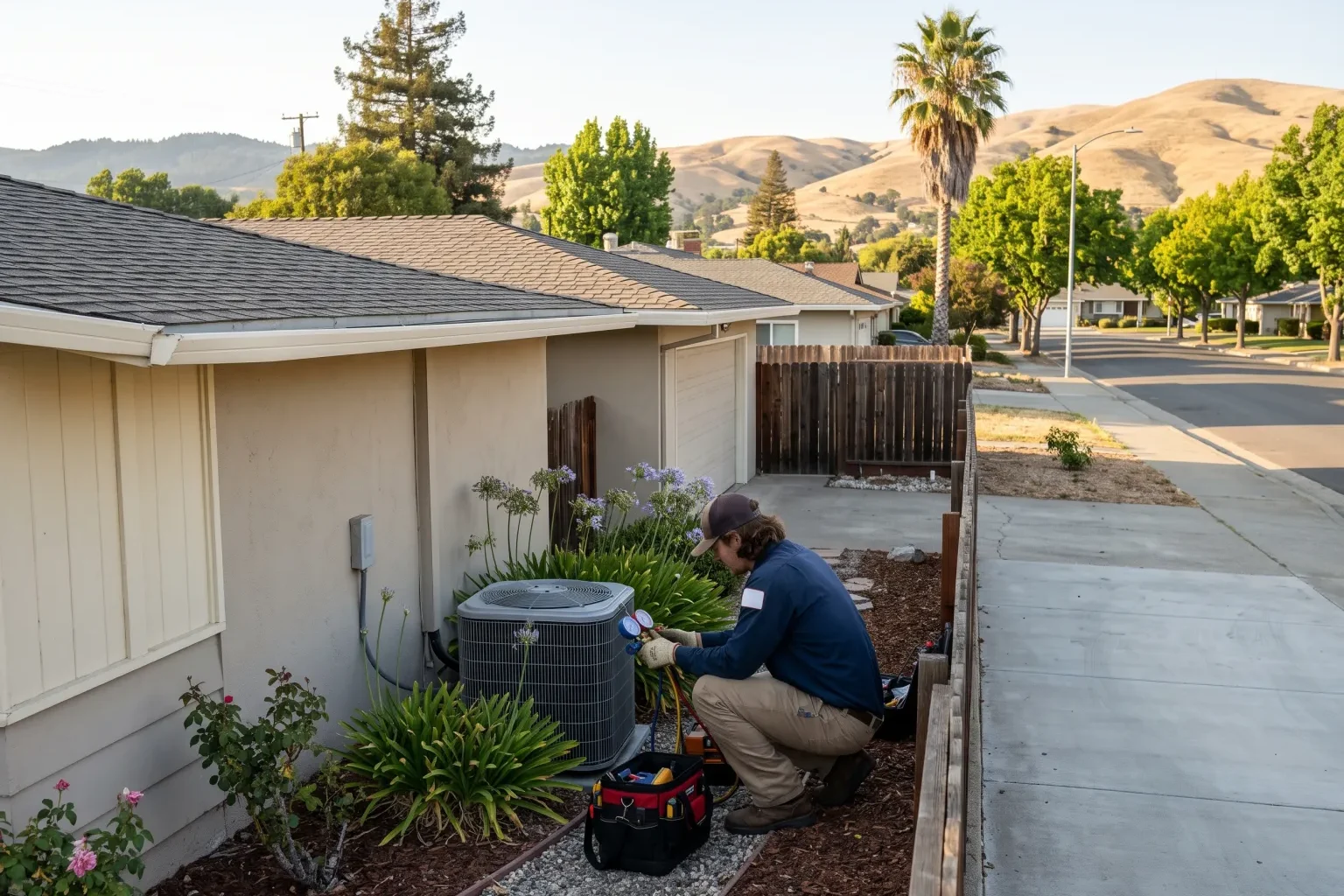
A good diagnosis follows the path the cooling actually takes: from the thermostat signal, through the indoor air handler and coil, out along the refrigerant lines to the condenser and back again. Skipping a step is how the wrong part gets replaced.
On the electrical side we test the capacitor, contactor, fuses, disconnect and wiring, and we measure how many amps the compressor and fan motor draw against their ratings. A capacitor that has drifted out of range is one of the most frequent causes of a condenser that hums without starting, particularly after a run of hot days.
For the refrigerant circuit we read operating pressures and line temperatures, then calculate superheat and subcooling. Those numbers tell us whether the charge is low, whether there is a restriction and whether the metering device is doing its job. If the charge is low, there is a leak somewhere, and we explain how we would locate it rather than simply topping the system off.
Airflow gets equal attention. We look at the filter, the blower wheel and motor, the evaporator coil surface and the return path. Many older San Jose homes have returns that are small for the air conditioner that was later added, and a restricted return can freeze a coil just as surely as low refrigerant. We also clear and test the condensate drain, since algae in the line is behind a lot of the water leaks we see.
Repair or replace: how we help you decide
Plenty of AC problems are straightforward fixes. A failed capacitor, a burned contactor, a clogged drain or a worn fan motor can be replaced and the system returned to normal service. In those cases we simply repair it.
The conversation changes when the fault is more serious or the system is older. A compressor failure, a leaking evaporator coil or a unit that relies on refrigerant that is no longer produced raises a fair question about whether money spent on repair is well spent. We do not answer that question for you. We describe the condition of the equipment, how it has likely been performing, whether parts are readily available and what each option would involve. Some homeowners prefer a repair that carries them through the season while they plan; others would rather move to a new system now.
If you are thinking about a heat pump instead of a separate air conditioner and furnace, we can talk through what your home would need. The federal 25C tax credit is no longer available for installations after the end of 2025, but BayREN and your local clean energy provider may offer current incentives, and we confirm any program before it appears in a quote.
What affects the cost of an AC repair
We do not publish set prices because the final figure depends on what the diagnosis uncovers. The factors that move it most are easy to understand, though:
- Which part failed, and whether it is a common component or a brand-specific one
- Whether the problem involves refrigerant, which adds leak search, recovery and recharge steps
- How easy the equipment is to reach, for example an attic air handler versus a garage unit
- The age of the system and whether replacement parts must be ordered
- Whether one repair uncovers a second issue, such as a damaged drain pan behind a clogged line
How an AC repair visit works
When you reach out, tell us what the system is doing, roughly how old it is and anything you have already tried, such as replacing the filter or resetting the breaker. We give you an arrival window. On arrival the technician asks a few questions, then starts testing at the thermostat and works through the system.
Once the cause is clear, you see the readings and hear the explanation in plain terms. You get the repair options and the price for each before anything is done. With your approval, the technician completes the repair, runs the system through a full cycle, checks the temperature drop across the coil and confirms the outdoor unit is operating within its normal range. Before leaving, we tidy the work area and give you a written summary of what was found and what was done, plus any items worth watching.