
The short answer
Call for furnace repair if the unit will not ignite, short-cycles, blows cold air, smells of gas or burning dust that lingers, or makes new noises. We test ignition, flame sensing, airflow, venting and safety controls, then repair the actual fault and confirm safe operation.
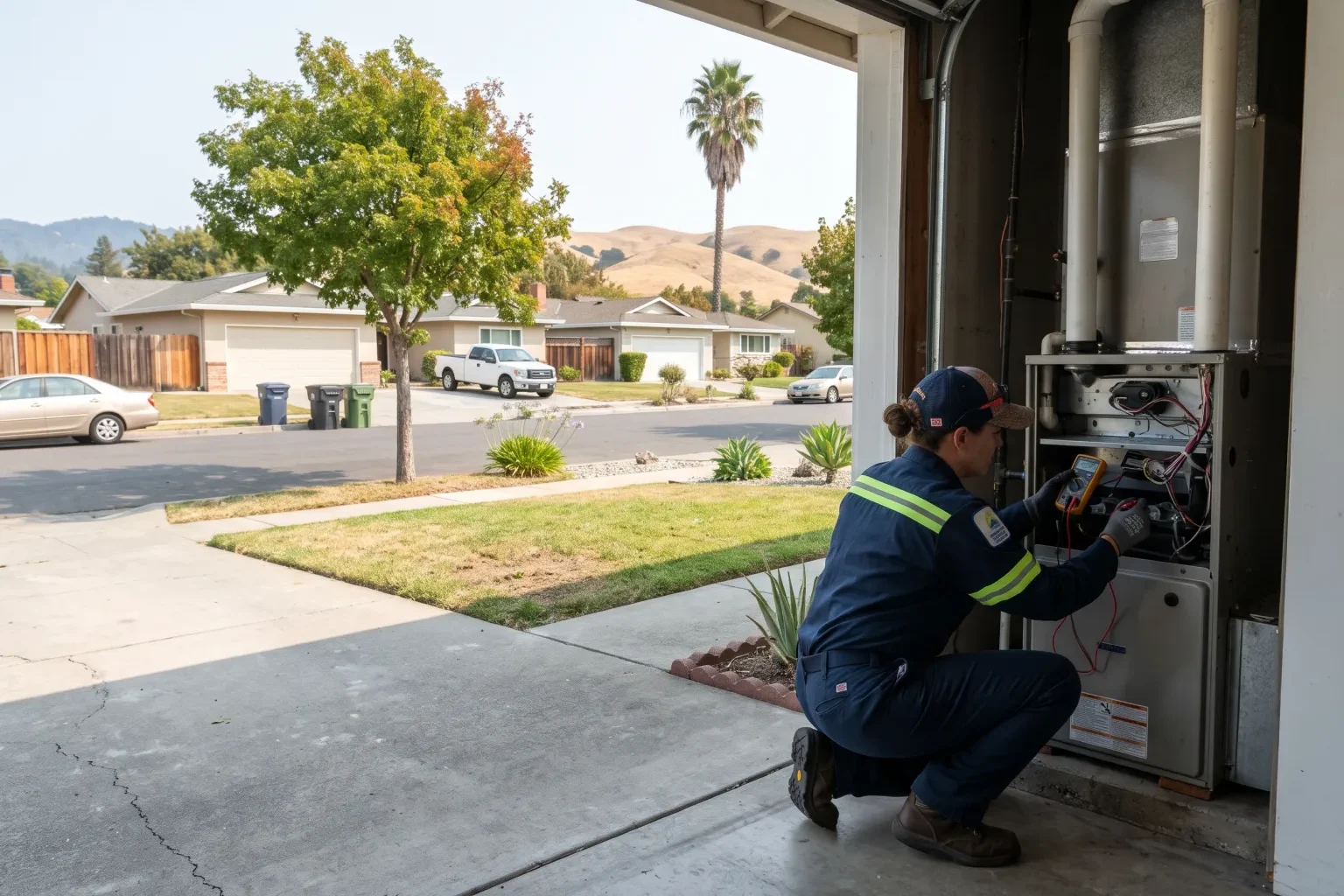
A furnace that clicks but never lights, blows cold air, or trips its own safety switch tends to fail on the first chilly evening of the season. ReliableAir HVAC Services repairs gas furnaces of every common brand and configuration in San Jose homes, from upflow units in hallway closets to horizontal models tucked into attics and crawlspaces. Our technicians trace the fault to its source, explain what broke and why, and fix it with the right part. If the repair no longer makes financial or safety sense, we tell you that too. Read on for the symptoms worth calling about, the components we test on every repair call, how we help you decide between fixing and replacing, and what shapes the price of a repair.
Symptoms that call for a technician
Some furnace issues are minor, and some point to a safety concern. Either way, these are the ones we hear about most often from South Bay homeowners when the first cool nights arrive in the fall:
- The thermostat calls for heat, the inducer motor runs, but the burners never light
- The burners light for a few seconds and then shut off again
- Air from the vents is lukewarm or cold while the furnace is running
- The blower runs nonstop, even when the thermostat is satisfied
- A dusty burning smell that does not fade after the first hour of the season
- Squealing, grinding or a loud bang when the burners come on
- Water pooling around a high-efficiency furnace
- The carbon monoxide alarm sounds or the furnace shows a flashing error code
Our diagnostic routine, step by step
We start by reading the control board's fault code and listening to the sequence of operation, because the point where startup stalls tells us a lot. From there we work through the system methodically rather than guessing and swapping parts.
Ignition and flame components come first. Hot surface igniters crack with age, and flame sensors build up a coating that keeps the board from proving flame, which causes the classic three-second shutdown. We check the gas valve, manifold pressure and burner condition, then move to the inducer motor and the pressure switch and its tubing, which are common trouble spots on high-efficiency units.
Airflow is next. A clogged filter, a weak blower capacitor, a dirty blower wheel or crushed ducts can cause the furnace to overheat and trip its high-limit switch. We measure temperature rise across the heat exchanger and compare it with the manufacturer's range. Finally, we inspect venting and draft, look over the heat exchanger for cracks, and test for carbon monoxide at the unit.
Deciding between a repair and a new unit
Most furnace calls end with a repair. Igniters, flame sensors, capacitors, pressure switches, limit switches, inducer motors and even control boards can be replaced, and doing so often adds years of service to a sound furnace.
A few findings change the conversation. A cracked heat exchanger can let combustion gases mix with the air you breathe, and on most older furnaces it is not a sensible repair. Repeated failures on an aging unit, parts that are no longer made, or a system that has never heated the house evenly can also tip the balance toward replacement. Keep in mind that the Bay Area Air District appliance rules do not require replacing working equipment; they apply only when a furnace fails or is replaced. We give you the facts, the options, and our honest view, and the decision stays yours.
What determines the repair bill
We provide the price for the repair after diagnosis and before any work begins, so you approve it first. The amount depends on the part involved and its availability, since a common igniter is a different job from a model-specific control board or an inducer assembly. Access also matters: a furnace in an open garage is quicker to work on than one in a cramped attic during a warm afternoon or deep in a crawlspace.
Other factors include whether the problem has caused secondary damage, such as a condensate leak that soaked the control board, and whether we find related issues like a cracked flue connector or a disconnected return duct that should be addressed at the same time. We separate must-fix safety items from optional improvements so you can prioritize.
Small habits that prevent the next breakdown
Many repair calls trace back to airflow. A filter left in place for a full year restricts the blower, raises the temperature inside the cabinet and eventually trips the limit switch or strains the motor. Checking the filter monthly during the heating season and replacing it when it looks gray is the simplest protection a homeowner has.
It also helps to keep the area around the furnace clear. Stored boxes, paint cans and laundry in a closet or garage can block combustion air and create a fire risk. On high-efficiency furnaces, make sure the condensate drain line is not kinked and the outdoor vent pipes are free of leaves, nests or debris. A yearly tune-up before the first cold weeks of fall lets a technician clean the flame sensor, test the igniter and catch weak parts before they leave you without heat.
What happens when you book a repair
When you contact us, we ask a few questions about what the furnace is doing, its approximate age and where it is located. That helps the technician bring likely parts. On arrival, the technician confirms the symptoms with you, runs the diagnostic process described above, and explains the cause in plain language, often showing you the worn part.
After you approve the repair, we complete it, then run the furnace through several full heating cycles. We verify ignition, flame stability, temperature rise, venting and safety switch operation, and we replace or recommend a fresh filter. Before leaving, the technician summarizes what was done and any items to keep an eye on. If something else looks like it may fail soon, we note it rather than pushing an immediate fix.
Furnace Repair by city
- Furnace Repair in Santa Clara
- Furnace Repair in Milpitas
- Furnace Repair in Sunnyvale
- Furnace Repair in Fremont
- Furnace Repair in Mountain View
- Furnace Repair in Newark
- Furnace Repair in Cupertino
- Furnace Repair in Los Altos
- Furnace Repair in Campbell
- Furnace Repair in Saratoga
- Furnace Repair in Palo Alto
- Furnace Repair in Los Altos Hills